Tokyo Dome: Capacity, Access & Japan's Original "Big Egg"
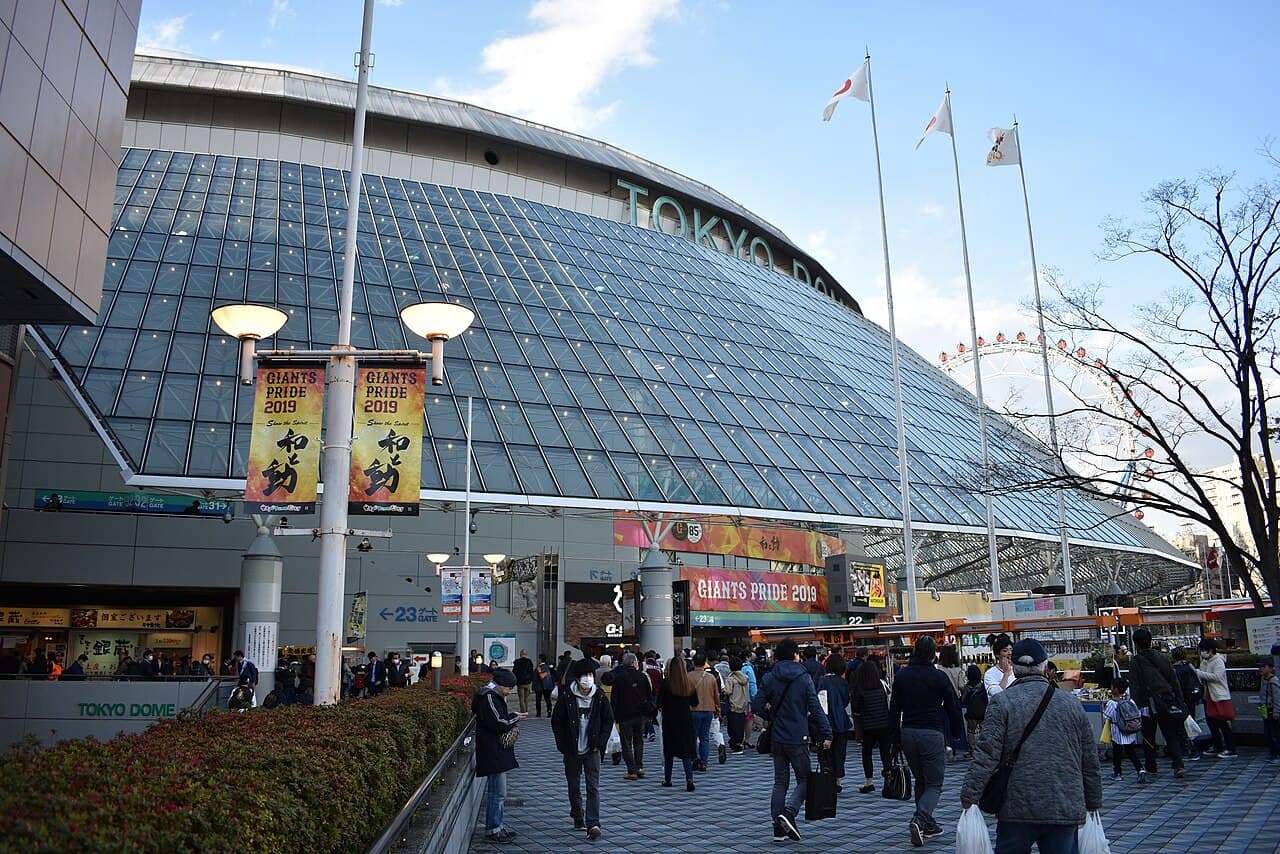
Tokyo Dome is Japan's largest dome-shaped arena and the country's first air-supported stadium, holding up to about 55,000 for its largest general-events configuration and roughly 43,500 for Yomiuri Giants baseball games. It sits about 2-3 minutes' walk from Korakuen Station and roughly 5 minutes from Suidobashi Station, in the Bunkyo ward of central Tokyo.
Capacity
| Configuration | Capacity |
|---|---|
| Concerts / general events (official maximum) | up to ~55,000 |
| Baseball (Yomiuri Giants home games) | ~43,500 |
The 55,000 figure is Tokyo Dome's own published general-events capacity, covering the infield/outfield stands plus a fully packed arena floor — it's the maximum the venue lists for concerts and other large-scale events, not a guarantee for any specific show. Tokyo Dome doesn't publish a separate figure for "typical" touring-concert configurations, so the actual capacity for any given concert depends on that show's stage, runway and platform layout, and can run lower than the maximum. For baseball, fixed seating around the diamond and outfield puts capacity at approximately 43,500. (Some secondary sources, including English Wikipedia's infobox, list slightly different figures for both configurations; this guide uses the numbers Tokyo Dome publishes on its own official site.)
Why it's called the "Big Egg"
Tokyo Dome's official opening date, per its operator's own company history page, is March 17, 1988 — the venue's first-ever game, a Yomiuri Giants–Hanshin Tigers exhibition match, was played the following day, March 18. It was Japan's first all-weather, air-supported dome stadium, earning it the nickname "Big Egg" for the shape of its pressurized fiberglass-membrane roof. It has served as the home ballpark of the Yomiuri Giants (Nippon Professional Baseball) since opening, and regularly hosts major concert tours, boxing, and professional wrestling cards (including many of New Japan Pro-Wrestling's biggest annual shows) in addition to baseball. The dome is the centerpiece of the wider Tokyo Dome City complex, which also includes an amusement park, the LaQua spa and shopping area, Korakuen Hall, and the Tokyo Dome Hotel.
Address
1-3-61 Koraku, Bunkyo-ku, Tokyo 112-0004 (〒112-0004 東京都文京区後楽1丁目3-61).
Getting there
- Korakuen Station (Tokyo Metro Marunouchi & Namboku lines), Exit 2 — about 2-3 minutes' walk
- Suidobashi Station, West Exit (JR Chuo-Sobu Line) — about 5 minutes' walk
- Suidobashi Station, Exit A2 (Toei Mita Line) — about 4-5 minutes' walk
- Kasuga Station (Toei Oedo Line), Exit 6 — about 5-6 minutes' walk
Both Korakuen and Suidobashi sit right at the edge of the Tokyo Dome City complex, so on event days simply follow the crowds and signage from either exit toward the dome's main gates.
FAQ
What is Tokyo Dome's capacity? Up to about 55,000 — the dome's official maximum capacity for general events, covering the stands plus a fully packed arena floor; actual concert capacity varies by show. Baseball games (Yomiuri Giants) seat around 43,500.
What's the nearest station? Korakuen Station (Tokyo Metro Marunouchi/Namboku lines), about 2-3 minutes' walk from Exit 2, or Suidobashi Station (JR Chuo-Sobu Line / Toei Mita Line), about 4-5 minutes' walk.
Why is Tokyo Dome nicknamed the "Big Egg"? It was Japan's first air-supported dome stadium, and its pressurized, egg-shaped fiberglass-membrane roof gave rise to the nickname when it opened in March 1988.
What events are held at Tokyo Dome? It's the home stadium of the Yomiuri Giants baseball team, and it regularly hosts large-scale concerts, boxing cards, and professional wrestling events, including major New Japan Pro-Wrestling shows.
Is Tokyo Dome the same as Tokyo Dome City? No — Tokyo Dome is the stadium itself. Tokyo Dome City is the larger surrounding complex that also includes an amusement park, the LaQua spa/shopping area, Korakuen Hall, and the Tokyo Dome Hotel.
Related venues
For other large Tokyo/Kanto venues, see Ariake Arena, K-Arena Yokohama, Saitama Super Arena, and Nippon Budokan. For mid-size live houses, browse the Zepp live-house guide.
Official venue pages: https://www.tokyo-dome.co.jp/en/dome/about/ and https://www.tokyo-dome.co.jp/en/dome/access/ (verified July 2026). Walking times are corroborated against independent Japanese route-guide measurements (see sources); the official site does not itself publish minute figures. Always check the official site for the current event calendar before booking travel around a show.
Frequently asked questions
- What is Tokyo Dome's capacity?
- Up to about 55,000 — the dome's official maximum capacity for general events, covering the stands plus a fully packed arena floor; actual concert capacity varies by show. Baseball games (Yomiuri Giants) seat around 43,500.
- What's the nearest station?
- Korakuen Station (Tokyo Metro Marunouchi/Namboku lines), about 2-3 minutes' walk from Exit 2, or Suidobashi Station (JR Chuo-Sobu Line / Toei Mita Line), about 4-5 minutes' walk.
- Why is Tokyo Dome nicknamed the "Big Egg"?
- It was Japan's first air-supported dome stadium, and its pressurized, egg-shaped fiberglass-membrane roof gave rise to the nickname when it opened in March 1988.
- What events are held at Tokyo Dome?
- It's the home stadium of the Yomiuri Giants baseball team, and it regularly hosts large-scale concerts, boxing cards, and professional wrestling events, including major New Japan Pro-Wrestling shows.
- Is Tokyo Dome the same as Tokyo Dome City?
- No — Tokyo Dome is the stadium itself. Tokyo Dome City is the larger surrounding complex that also includes an amusement park, the LaQua spa/shopping area, Korakuen Hall, and the Tokyo Dome Hotel.
- Is Tokyo Dome the biggest stadium in Japan?
- No. Tokyo Dome's maximum is about 55,000 (roughly 43,500 for baseball), while Japan's largest stadium — the open-air Nissan Stadium in Yokohama — seats 72,327, and Japan National Stadium in Tokyo seats 67,750. What Tokyo Dome has that they do not is a roof: it was Japan's first air-supported dome stadium when it opened in 1988, so its games and concerts run in any weather.