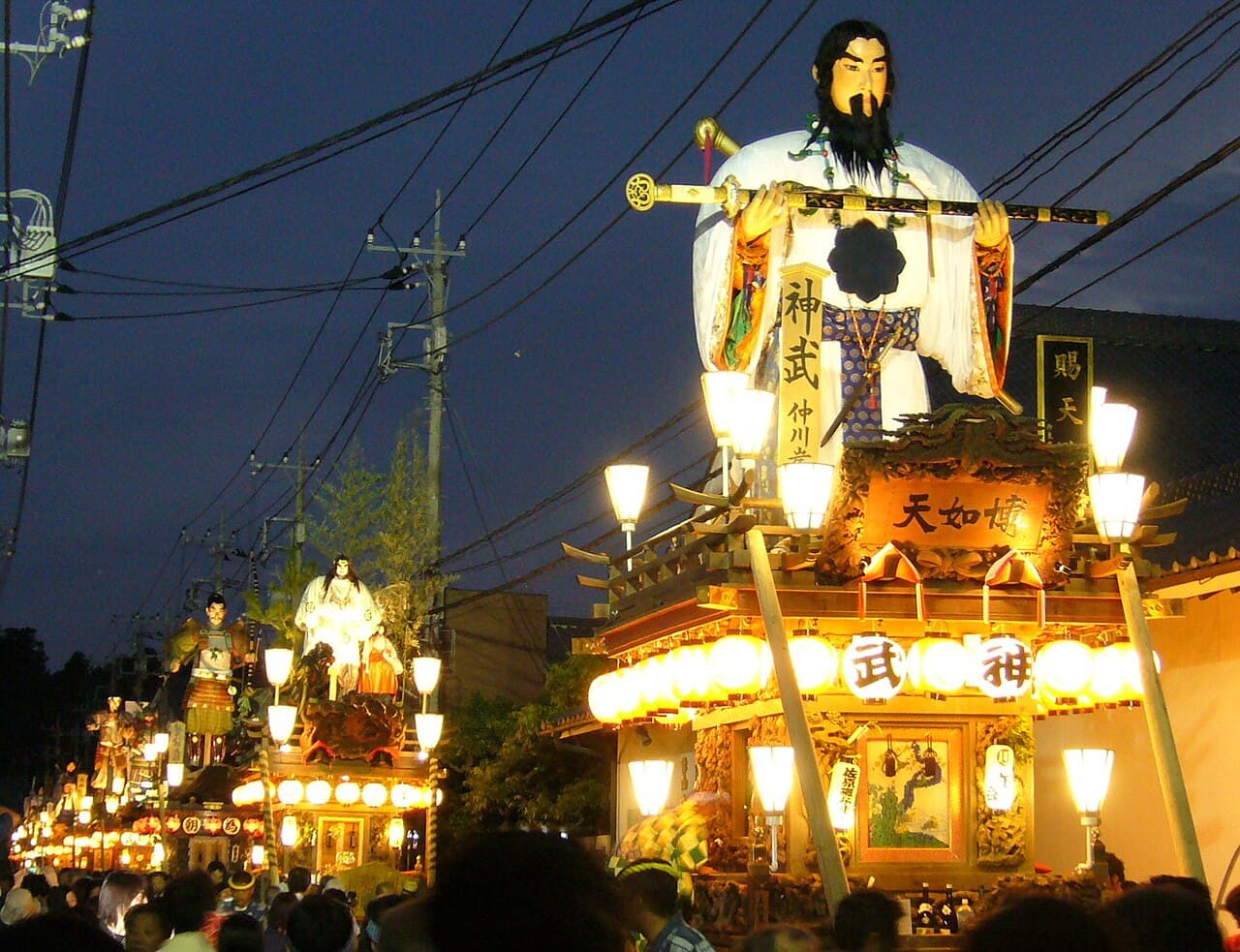
Highlights
- Fourteen zelkova-wood floats, each crowned by a huge doll (often 4 metres or more) of a legendary or historical figure crafted by Edo- and Meiji-era doll makers, hauled through the old merchant town to Sawara-bayashi flute-and-drum music
- The showpiece 'nonoji-mawashi' - crews spin a several-tonne float in a tight figure-of-eight at street corners - plus lantern-lit night processions through the canal-side townscape
- One of the Kanto region's three great float festivals (with Kawagoe and Ishioka); the 'Sawara float event' is a national Important Intangible Folk Cultural Property (2004) and part of the UNESCO-inscribed float festivals (2016)
Background & story
The Sawara Grand Festival has roughly 300 years of history in a prosperous Edo-period river-trade town so refined it was nicknamed 'Little Edo'. It is held twice a year as the附祭 (adjunct festival) of two shrines - Yasaka Shrine in summer (Honjuku district) and Suwa Shrine in autumn (Shinsuku district, 14 floats). The 'Sawara float event' was designated a national Important Intangible Folk Cultural Property in 2004 and inscribed by UNESCO in December 2016 among the 33 'Yama, Hoko and Yatai' festivals.
Good to know for visitors
- Getting there
- From Tokyo, take the JR Sobu/Narita Line to Sawara Station (roughly 1.5-2 hours, usually changing at Narita), or a highway bus from Tokyo Station (about 85 minutes). The 14 floats parade the Shinsuku-district streets on the west bank of the Onogawa, only a few minutes' walk from Sawara Station; Suwa Shrine itself is about a 10-minute walk. JR East has run seasonal 'Ayame' festival express trains on peak weekends in the past, so check the 2026 timetable closer to the dates. Open directions in Google Maps ↗
- Booking & entry
- Free to attend — details on the official page (button above).
- Language
- Mostly in Japanese — a translation app on your phone helps.
- Good for
- culture seekers
Good to know
As an easy day-trip from Tokyo, aim to arrive by mid-morning to see the floats in daylight, then linger for the lantern-lit evening run, which many regulars rate as the most atmospheric. The old townscape gets crowded and roads close, so come by train and check the road-closure map on the Katori City site first.
Getting there
Shinsuku district streets (Suwa Shrine autumn festival), west bank of the Onogawa canal, Sawara, Katori — Sawara, Katori City, Chiba 287-0041 (Suwa Shrine and the Shinsuku district)