Highlights
- Three paid enbujo: Aiba-hama (~4,600), Minami-uchimachi (~2,700), Konya-machi (~2,200)
- 2026 reserved seats ¥3,000 (S) to ¥1,000 (C); Minami-uchimachi adds SS ¥6,000 / Special ¥15,000
- Buy via awaodorimirai.com → Ticket Pia, with 7-Eleven convenience-store pickup
Background & story
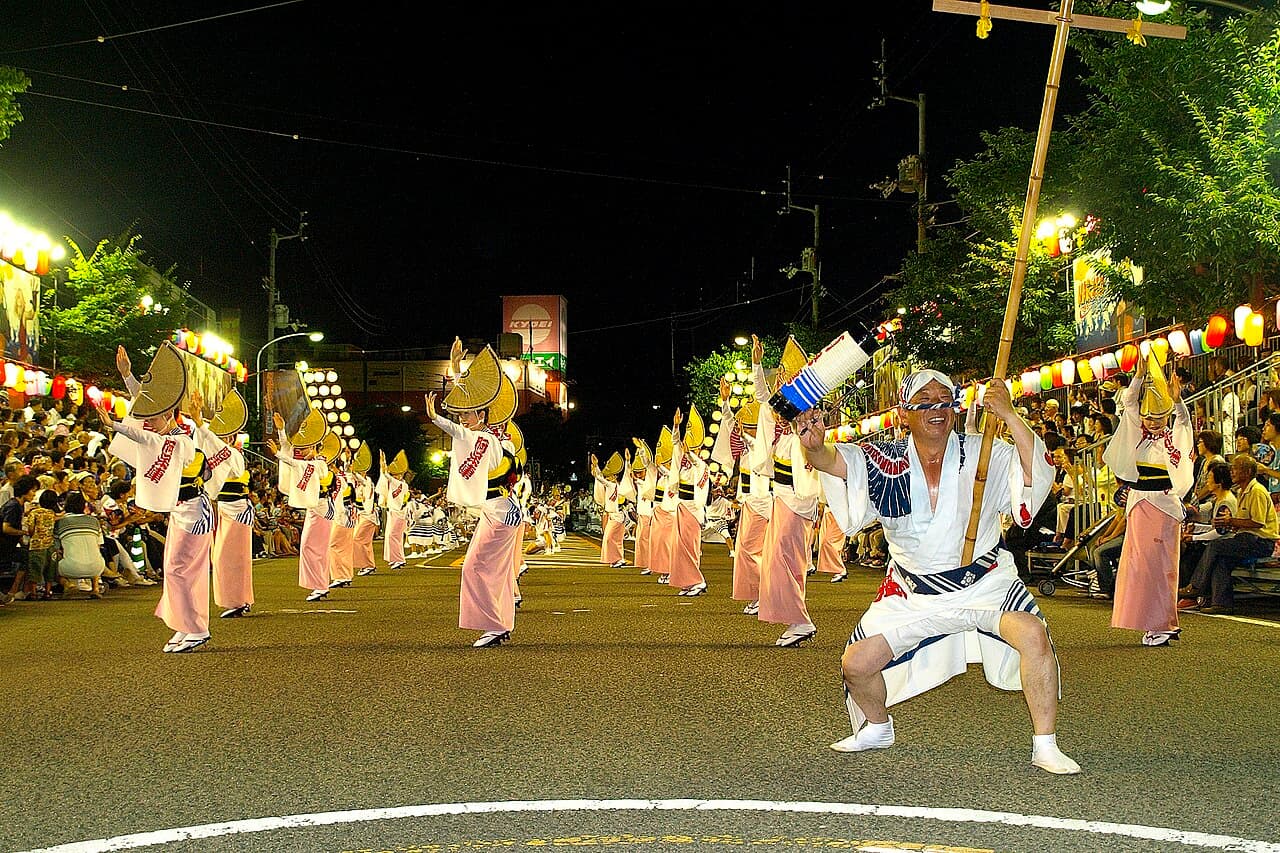
Awa Odori grew from Bon-odori dances in Tokushima and is held over four August nights; the paid grandstands (enbujo) line the dance arenas so spectators get a head-on view of the ren troupes.
Tokushima's Awa Odori (Aug 12–15, 2026) is Japan's most famous dance festival — and the front-row way to see it is a paid grandstand seat at one of the riverside dance arenas (enbujo). The street view is free, but the choreographed ren (dance troupes) face the paid stands head-on. This page is the verified how-to-buy; for the wider logic see how to buy summer-matsuri grandstand seats, and for another festival see Aomori Nebuta 2026 reserved seats.
2026 dates
- *Dance period (outdoor enbujo):* August 12 (Wed) – 15 (Sat), 2026
- Nightly blocks: Part 1 around 18:00–19:40 and Part 2 around 20:20–22:00
- (August 11 is an indoor opening performance only.)
The paid grandstand arenas
There are three outdoor paid enbujo, all running Aug 12–15:
- Aiba-hama Enbujo (藍場浜) — the largest (~4,600 seats), in Aiba-hama Park along the Shinmachi River, closest to JR Tokushima Station.
- Minami-uchimachi Enbujo (南内町) — ~2,700 seats, adds higher VIP tiers.
- Konya-machi Enbujo (紺屋町) — ~2,200 seats, at the foot of Mt. Bizan.
2026 seat prices
At Aiba-hama and Konya-machi:
- S seat (reserved): ¥3,000
- A seat (reserved): ¥2,500
- B seat (reserved): ¥2,000
- C seat (unreserved within the paid area): ¥1,000
Minami-uchimachi adds Special ¥15,000 and SS ¥6,000 on top of the S/A/B/C tiers. Children under 3 are free on a lap; ages 3+ need a ticket. Note: the Aug 13 Konya-machi second block is special all-free-seating.
How and when to buy in 2026
- A web pre-sale (seat-selectable) ran June 13–21, 2026 via Ticket Pia and the official site — this window has closed. A general sale follows; check the official site for current availability and any remaining rounds.
- Buy through the official portal (awaodorimirai.com), which routes to Ticket Pia. Reserved tickets are commonly collected at a 7-Eleven convenience store.
- Register a Ticket Pia account in advance, and have your reservation number ready for convenience-store pickup.
Getting to Tokushima
- Nearest station: JR Tokushima Station — all three arenas are clustered just south of it.
- From Osaka: the easy option is the highway bus to Tokushima Station, about 2.5 hours, ~¥4,100 one-way (very frequent); or train via Takamatsu, ~2–3 hours.
- From Tokyo: Shinkansen to Okayama then limited express via Takamatsu, roughly 5–6 hours, ~¥19,000; or an overnight bus; flights Haneda → Tokushima Airport also run.
Inbound tip
Book your hotel for the festival nights months ahead — Tokushima is a compact city and rooms vanish long before seats do. Carry cash for stalls and convenience-store ticket pickup.
Official: awaodorimirai.com. Always confirm the current on-sale window and prices on the official page before paying — Awa Odori updates them each year.
Good to know for visitors
- Getting there
- All three paid enbujo are clustered just south of JR Tokushima Station. From Osaka, the highway bus to Tokushima Station is ~2.5h / ~¥4,100; from Tokyo, Shinkansen via Okayama + limited express via Takamatsu is ~5–6h. Open directions in Google Maps ↗
- Booking & entry
- Check tickets and details on the official page (button above).
- Paying
- Reserved grandstand ¥1,000 (C) – ¥3,000 (S); Minami-uchimachi SS ¥6,000 / Special ¥15,000. Smaller venues in Japan are often cash-first — carry some yen (cards/IC not guaranteed).
- Language
- Mostly in Japanese — a translation app on your phone helps.
- Good for
- culture seekers, families, groups of friends
Good to know
Book a hotel months ahead and carry cash — Tokushima is compact and rooms sell out before the seats do.
Frequently asked questions
- When is Awa Odori 2026 held?
- Tokushima's Awa Odori runs August 12–15, 2026, on the main festival days (Matsuri-bi), preceded by an indoor opening gala on August 11. Evening street performances take place roughly 18:00–22:00, split into two ticketed blocks — 18:00–19:40 and 20:20–22:00 — with a seat exchange between them.
- Do you need a ticket, or can you watch for free?
- You don't need a ticket to enjoy Awa Odori. Free, first-come outdoor viewing areas and small dance plazas run throughout the streets, while the paid grandstands (sajiki) host many of the top dance troupes (ren). Buy a seat if you want a guaranteed close-up view of the best performers.
- When do 2026 tickets go on sale and how do you buy them?
- As of July 2026, tickets sell in two phases: a web presale (June 13–21, 2026) and general sale from July 1, 2026, via Ticket Pia and the official Awa Odori website. English-speaking buyers can pay by card online and print their tickets at a 7-Eleven convenience store; check the official site for the exact July 1 start time.
- How much do the paid grandstand seats cost?
- As of July 2026, main-day grandstand (sajiki) seats are roughly SS ¥6,000, S ¥3,000, A ¥2,500, B ¥2,000, and C (unreserved) ¥1,000 per performance block, plus service fees. Prices can vary by venue and block, and these tiers come from Japan-travel sources — reconfirm against the official Ticket Pia listing before treating them as definitive.
- Which grandstand venue is best?
- Aibahama (Sansan Aibahama) is the most convenient for visitors because it's the closest venue to JR Tokushima Station — about a 5-minute walk — making the last train easy to catch. The paid grandstand venues are Aibahama, Minami-uchimachi, and Konnya-machi; note the Aug 13 Konnya-machi second block is all-unreserved seating.
- How do you get to Tokushima?
- Frequent daytime highway buses connect Osaka to Tokushima in roughly 2.5 to 3 hours for about ¥4,100 one-way (as of mid-2026). Tokushima Airport also links the city to major Japanese cities, giving flyers an alternative to the bus or train.
Getting there
Outdoor paid dance arenas (Aiba-hama / Minami-uchimachi / Konya-machi), Tokushima City — Aiba-hama Park and central Tokushima City, Tokushima Prefecture